The Hartland covered bridge spans the Saint John River at Hartland, New Brunswick. It is widely recognised as the longest covered bridge in the world and is designated as a National Historic Site of Canada. For a structure of its length, the engineering question is straightforward but demanding: how do you carry a wooden bridge across a wide river without a single span long enough to do it alone?
A bridge built in panels
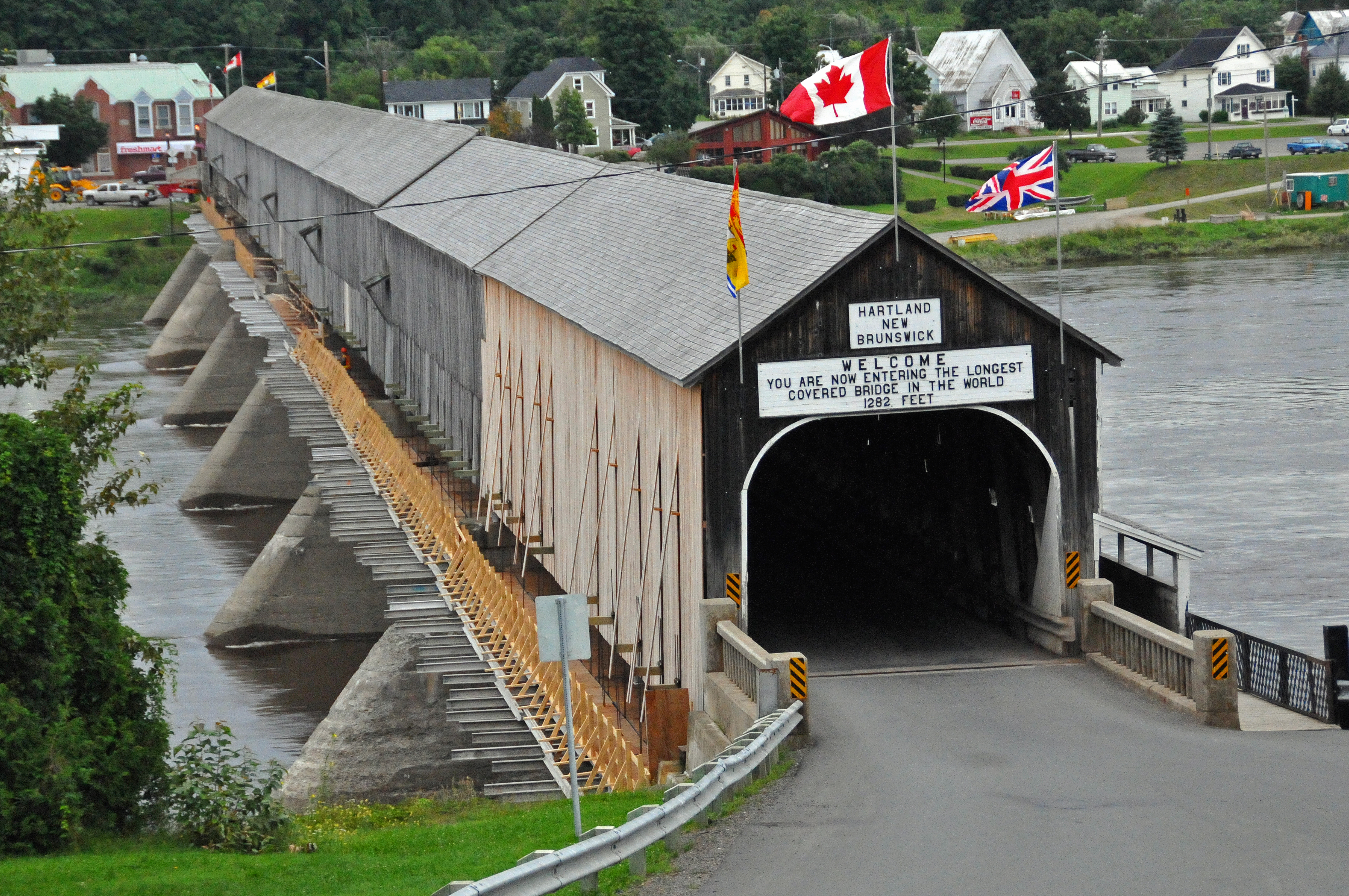
The answer at Hartland was to build the crossing as a series of separate truss spans resting on piers in the river, rather than one continuous structure. Each span is its own truss; the piers carry the loads down to the riverbed. This is the standard solution for any long bridge — the river is divided into manageable lengths, and each length is bridged on its own terms.
- Multiple timber truss spans set end to end.
- Masonry and later concrete piers between spans.
- A continuous roof and siding running the full length once the bridge was covered.
Open first, covered later
The crossing at Hartland did not begin life as a covered bridge. It first opened as an uncovered timber structure in the early twentieth century. The covering — the roof and siding that protect the trusses — was added afterward. That sequence is common: the cover is a maintenance investment, and communities sometimes added it once they saw how quickly an exposed wooden bridge deteriorated.
An exposed wooden truss is repeatedly soaked and dried, which loosens joints and invites rot. A roof and walls keep the structural timber dry, and the cladding can be replaced cheaply over the years while the truss is preserved.

Living infrastructure
Hartland is not a museum piece set aside from traffic. It continues to carry vehicles, which means it has to meet practical demands — clearance, deck condition, load limits — that a purely ceremonial structure would not. Maintaining a historic timber bridge in active service requires balancing heritage value against the realities of modern road use.
| Location | Hartland, New Brunswick |
|---|---|
| Crosses | Saint John River |
| Distinction | Longest covered bridge in the world |
| Designation | National Historic Site of Canada |
| Construction | Multiple truss spans on river piers |
What Hartland teaches
The Hartland bridge shows that "covered bridge" describes a maintenance strategy as much as a style. The length record draws visitors, but the more instructive lesson is structural: a long timber crossing is an assembly of ordinary spans, kept alive by the roof over them and by ongoing repair.